RIVAL CLAIMS TO AGE
What is the oldest church in Trastevere?
Why Santa Maria in Trastevere, not Santa Cecilia, holds the strongest claim to being the rione's oldest church.
The answer in full
Read on
The oldest claim: Santa Maria in Trastevere
Ask which church in Trastevere is oldest and the long-standing answer is Santa Maria in Trastevere, the rione's great church on its central square. Tradition holds that Pope Callixtus I founded a house-church on the spot about the year 220, on the site of a refuge that had sheltered retired soldiers. No other church in the neighborhood claims so early a start.
The claim goes further than age alone. An inscription on the church's episcopal throne calls it the first church in Rome dedicated to the Virgin Mary, a distinction that Santa Maria Maggiore disputes on its own behalf. Either way, Santa Maria in Trastevere is certainly among the oldest churches anywhere in the city, not only in this rione.
The church stands where it has stood, in one form or another, for roughly eighteen centuries, facing the piazza that still carries its name and that has long served as the neighborhood's gathering point. Markets and crowds have passed across this square for generations, with the church as their fixed anchor.
A church rebuilt more than once
Age of foundation is not the same thing as age of surviving fabric. The third-century house-church did not survive unchanged: it was rebuilt in 340, already showing how quickly early Christian Rome outgrew its first modest buildings. Nothing from either the original house-church or the fourth-century rebuilding survives above ground today.
A second and far more thorough rebuilding followed on the old foundations between 1140 and 1143, and that medieval campaign gave the church most of the body it keeps today, including its basilica plan and many of its surviving decorations. By the twelfth century, in other words, the church had already been rebuilt at least twice.
So the church's claim to be the oldest in Trastevere rests on continuity, the unbroken use of one site and one dedication since the third century, rather than on any single standing wall. That is true of many of Rome's oldest churches, where worship, not masonry, is the thread running back furthest.
What the present building preserves
The façade carries a thirteenth-century mosaic of the Madonna nursing the Child, flanked by ten women holding lamps, a striking image above the square. Inside, the nave is divided by twenty-two granite columns taken from the ruins of the Baths of Caracalla, reused as building stone centuries after the baths fell out of use.
Scholars once identified Egyptian gods among the faces carved on the columns' capitals; in 1870 those faces were hammered off, a reminder that an ancient church's fabric keeps changing long after its founding. The apse mosaic shows the Coronation of the Virgin, with Pope Innocent II holding a model of the church he rebuilt.
Below the mosaic survive Pietro Cavallini's scenes of the Life of the Virgin, painted in 1291, among the finest medieval frescoes in the city. In the square outside, the octagonal fountain already appears on a map drawn in 1472, evidence of how long this spot has served as Trastevere's center, centuries before most of the surrounding houses took their present shape.
The rival across the rione: Santa Cecilia
Toward the river stands Santa Cecilia, dedicated to the patron saint of music, a young Roman woman said to have been martyred in the third century. Tradition holds that the church rises directly over her own house, and remains of a Roman house have indeed been found beneath the present building, lending the story some physical support.
That domestic site may be as old as, or older than, the house-church behind Santa Maria in Trastevere, but the church built over it took shape later: the present Santa Cecilia was rebuilt in the ninth century, well after Callixtus I's first foundation across the rione, by which time Santa Maria in Trastevere had already stood for some six centuries.
Inside, before the altar, lies Stefano Maderno's marble statue of Saint Cecilia, carved in 1600. A slab in front of it records his sworn statement that he depicted her exactly as he saw her when her tomb was opened in 1599, linking an old legend to a specific, dated event.
In the nuns' choir survives part of Pietro Cavallini's fresco of the Last Judgment, painted between 1289 and 1293, close in date to his work at Santa Maria in Trastevere. The two churches, in other words, share both an artist and a long rivalry for the title of oldest in the rione.
An even older building, but not a church
If the question is widened from churches to religious buildings generally, Trastevere holds something older than either: Rome's oldest surviving synagogue building. It was built in 980 and converted into a synagogue in 1073 by the scholar Nathan ben Yechiel, predating the medieval rebuilding of Santa Maria in Trastevere by more than a century.
Its use as a synagogue ended in the sixteenth century, when Rome's Jewish community was forced across the river into the ghetto, closing a chapter of Trastevere's history as home to immigrants from the East, mainly Jews and Syrians, who had settled on this bank since the time of the Republic.
The building is not a church and does not compete for that title, but it is a useful reminder that Trastevere's oldest standing structures are not all Christian, and that the rione's religious history runs in more than one direction at once, a fact worth remembering while walking between the two churches on either side of the rione.
Why the distinction matters
Calling one church 'the oldest' can mean several different things at once: the oldest foundation date, the oldest surviving fabric, or the oldest continuous use of a single site. Trastevere's two great churches answer these measures differently, which is part of why the rivalry between them has lasted so long.
By foundation date, Santa Maria in Trastevere wins outright: a house-church on its site is said to go back to about 220, centuries before Santa Cecilia's present building was raised over its Roman house in the ninth century, even if that underlying house may itself be very old, perhaps older than the church that now stands above it.
By surviving fabric, the comparison flips: Santa Cecilia's ninth-century rebuilding is three centuries older than Santa Maria in Trastevere's rebuilding of 1140 to 1143, which is the campaign that gave the larger church most of what stands today. On this measure, more of Santa Cecilia's present body is older brick and stone than more of Santa Maria's.
Finding both churches
Santa Maria in Trastevere and Santa Cecilia both lie within easy walking distance of one another, on opposite sides of the rione, with Santa Maria on the central square and Santa Cecilia closer to the river. Either makes a natural stop on a walk through the neighborhood's narrow lanes and markets.
Both remain working churches rather than museums, so visitors should check each one's own notices for anything specific to that building on the day of the visit. General guidance on dress, respectful behavior and getting around the rione is covered on the neighborhood's own page rather than repeated again here.
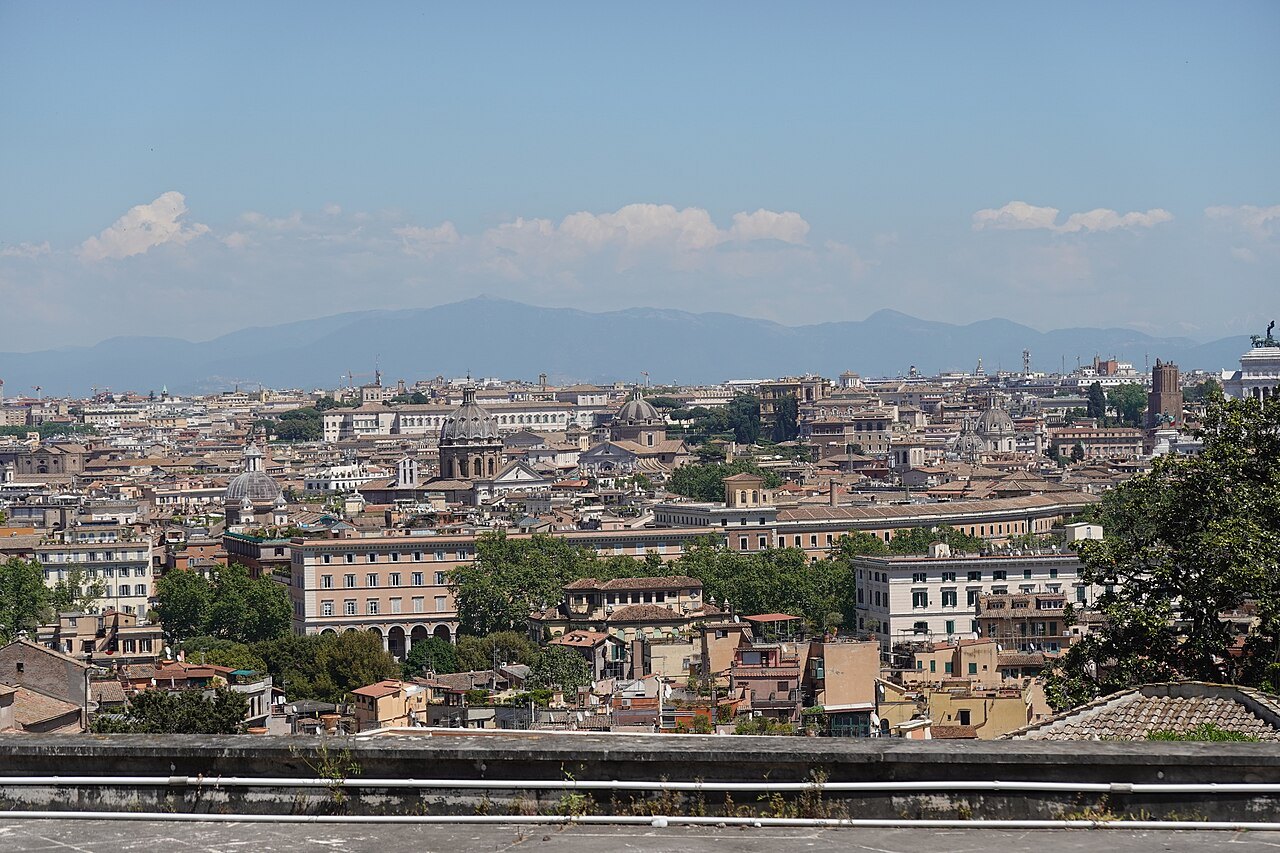
For a longer walk that places these two churches alongside Trastevere's other landmarks, from the Villa Farnesina to the Janiculum above it, a route covering the whole rione is worth following at an unhurried pace, since neither church takes long to see on its own, and both reward a second look at details easily missed on a first pass.
Read next
More from the journal
- The Borghese Gallery and its GardensHow did Bernini make marble look like skin?Inside the Borghese Gallery, where Bernini carved marble into skin, bark, and breath.Read the piece →
- The RioniWhy are the districts of Rome called rioni?Old Rome is divided into twenty-two rioni, numbered from Monti to Prati, and their names are carved at street corners. Where the word comes from, how fourteen ancient regions became twenty-two modern districts, what the 1744 plaques are, and how to use the numbers to find your way.Read the piece →
- The Capitoline Hill and its MuseumsHow did the statue of Marcus Aurelius survive the Middle Ages?Why the gilded bronze horseman on the Capitoline escaped the melting pots that claimed almost every other Roman emperor.Read the piece →