ANCIENT EGYPT MEETS BAROQUE ROME
How did an Egyptian obelisk come to stand in Piazza del Popolo?
How Augustus, Domenico Fontana and Pope Sixtus V brought a pharaoh's obelisk to the center of Piazza del Popolo.
The answer in full
Read on
An obelisk older than Rome
At the center of Piazza del Popolo stands a pink granite obelisk that was ancient long before Augustus ever set eyes on it. It ranks among the oldest and tallest obelisks in Rome, rising about seventy-nine feet, or about one hundred eighteen feet counting its base and the four lions around it. For centuries it was the first tall thing a traveler saw on riding through the Porta del Popolo into the city.
Three of its four sides were carved in the reign of the pharaoh Sety I, the fourth under his son Rameses II, at Heliopolis, the ancient Egyptian city of the sun god. The obelisk had already stood on Egyptian soil for well over a thousand years by the time Rome existed as more than a village on the Tiber.
Augustus brought the obelisk to Rome in 1 BC, after Egypt had become a Roman province, and set it up in the Circus Maximus as a trophy of the conquest. It stood there among chariot races for centuries before Domenico Fontana lifted it from the ground and carried it across the city for Pope Sixtus V.
Domenico Fontana's engineering feat
Domenico Fontana was the engineer behind Pope Sixtus V's plan to place ancient obelisks at key points across Rome, turning them into landmarks that oriented pilgrims and travelers moving between the city's great basilicas. In 1589 he raised the obelisk now known as the Flaminio obelisk at Piazza del Popolo, setting it exactly on the axis of the square just inside the Porta del Popolo.
Placing the obelisk here meant that anyone entering Rome from the north along the Via Flaminia met it first, long before reaching the Capitoline or the Vatican. The choice made the obelisk a kind of welcome marker, a pagan monument repurposed to announce the Christian city beyond the gate, part of Sixtus V's wider remaking of Rome for the pilgrims who filled its streets.
Moving an obelisk of this size without modern machinery was a considerable feat, and Fontana's success at Piazza del Popolo and elsewhere in the city made his reputation as the pope's chief engineer. The obelisk has stood on this spot, undisturbed, since that year, a fixed point as the square around it was rebuilt again and again in the centuries that followed.
The obelisk inside Valadier's square
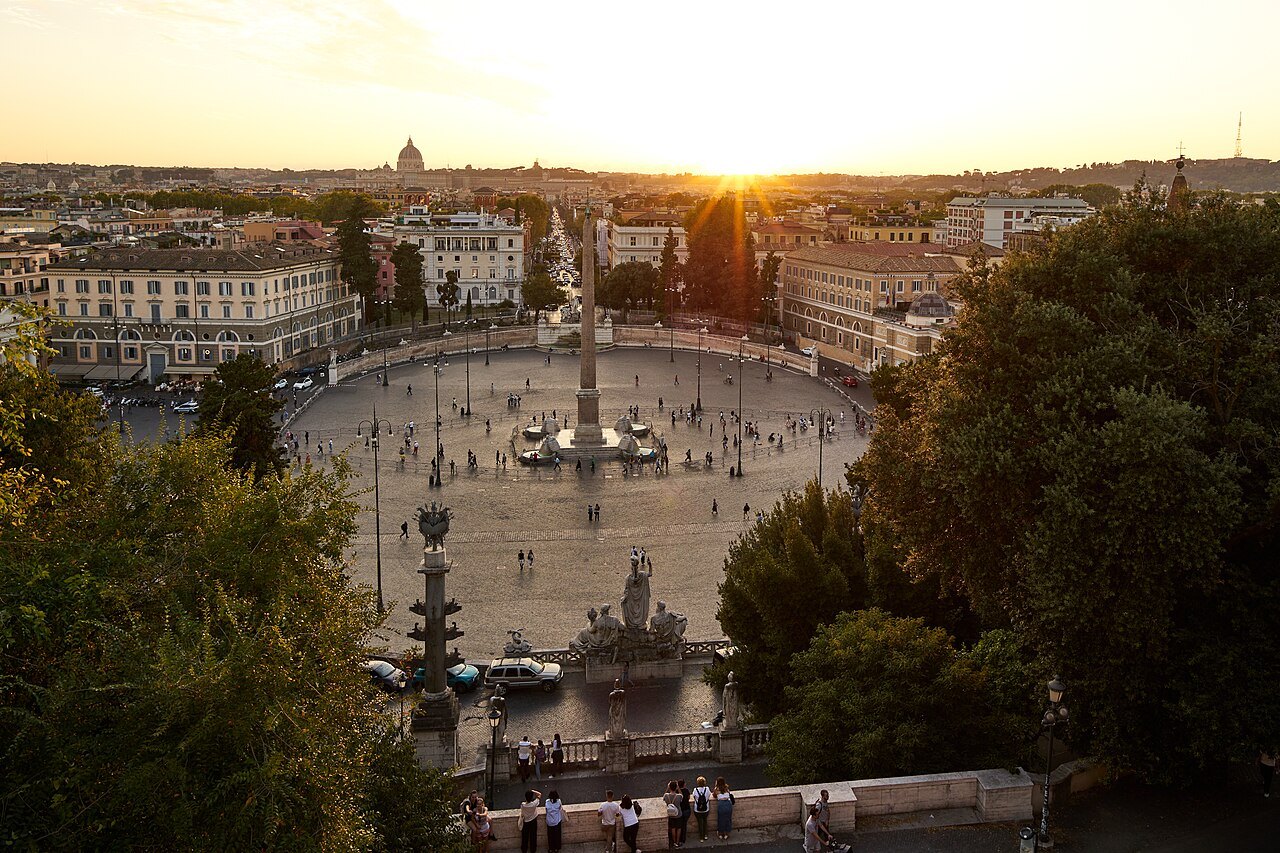
When Giuseppe Valadier redesigned Piazza del Popolo between 1811 and 1822, he kept Fontana's obelisk exactly where it stood and built the whole oval of the square around it, making it the fixed point from which the three streets of the Tridente fan out to the south. Walking in from Via del Corso, the obelisk is the first thing that draws the eye across the open space.
Around its base stand four stone lions, added in 1818, each spouting a thin jet of water into a small basin, a Rococo-tinged touch set beneath an Egyptian monument almost two thousand years older than the square itself. They give the obelisk a base worth walking all the way around rather than viewing only from a distance.
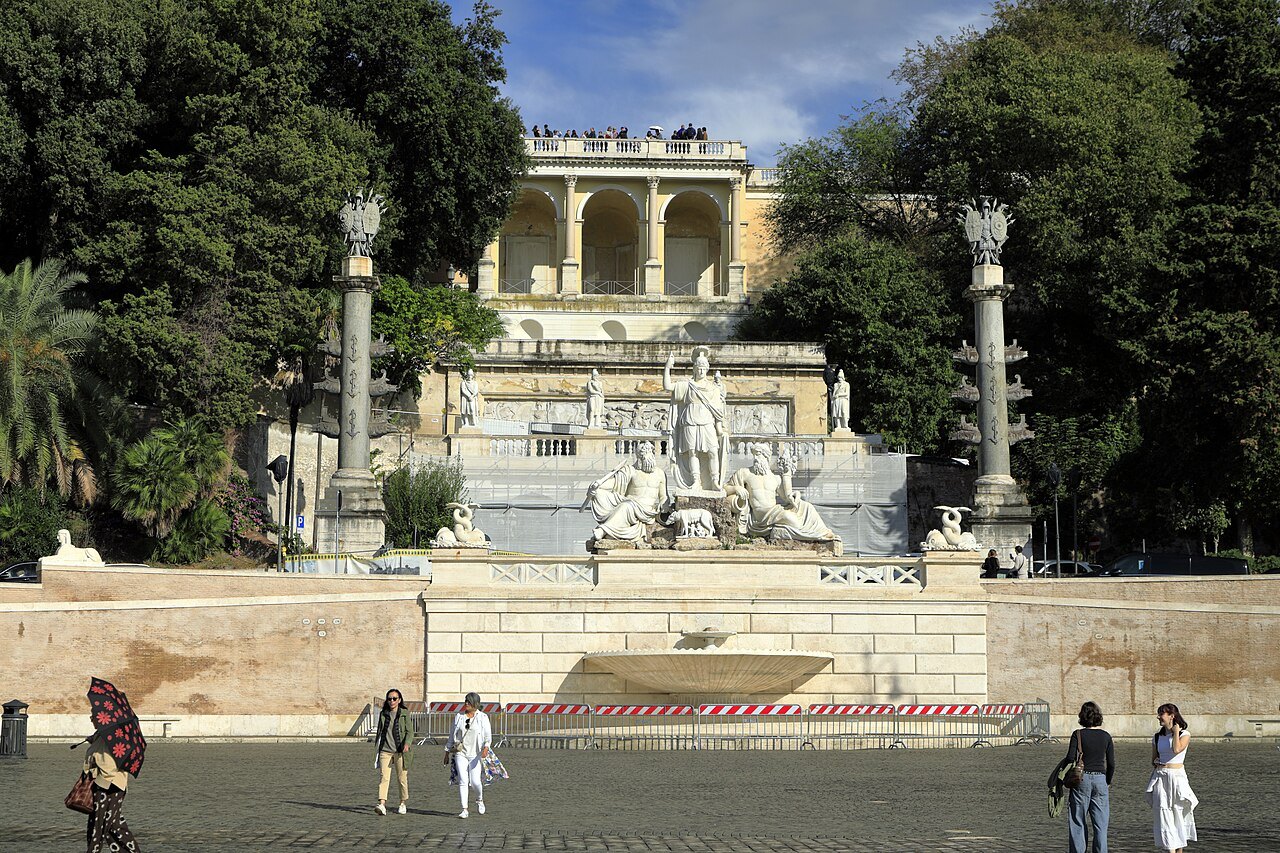
On either side of the obelisk, two fountains by Giovanni Ceccarini complete the composition: Neptune and his Tritons to the west, and Roma enthroned above the Tiber and the Aniene to the east, with the she-wolf and the twins at her feet. Together with the obelisk, they turn the center of the square into a single layered monument spanning Egypt, ancient Rome, and the nineteenth century.
Two pharaohs and a sacred city
The hieroglyphic inscriptions covering three faces of the obelisk date from the reign of Sety I, while the fourth face was added later under his son Rameses II, suggesting work was finished sometime after the father's death. Obelisks like this one stood in pairs at the entrances of Egyptian temples, dedicated to the sun god worshipped at Heliopolis, their tapering shape thought to catch the first and last light of the day.
By the time Augustus annexed Egypt as a Roman province, obelisks such as this one had already stood at Heliopolis for well over a thousand years, witnesses to dynasties that had risen and fallen long before Rome was founded. Bringing one to the capital was a deliberate display of the reach of Roman power into the oldest civilization the Romans knew.
Rome eventually raised several of these transplanted obelisks at prominent points across the city, each one a fragment of Egyptian religious architecture turned into Christian urban furniture; the one at Piazza del Popolo is among the oldest and tallest of that group still standing where it was placed in the sixteenth century.
The obelisk and the Tridente
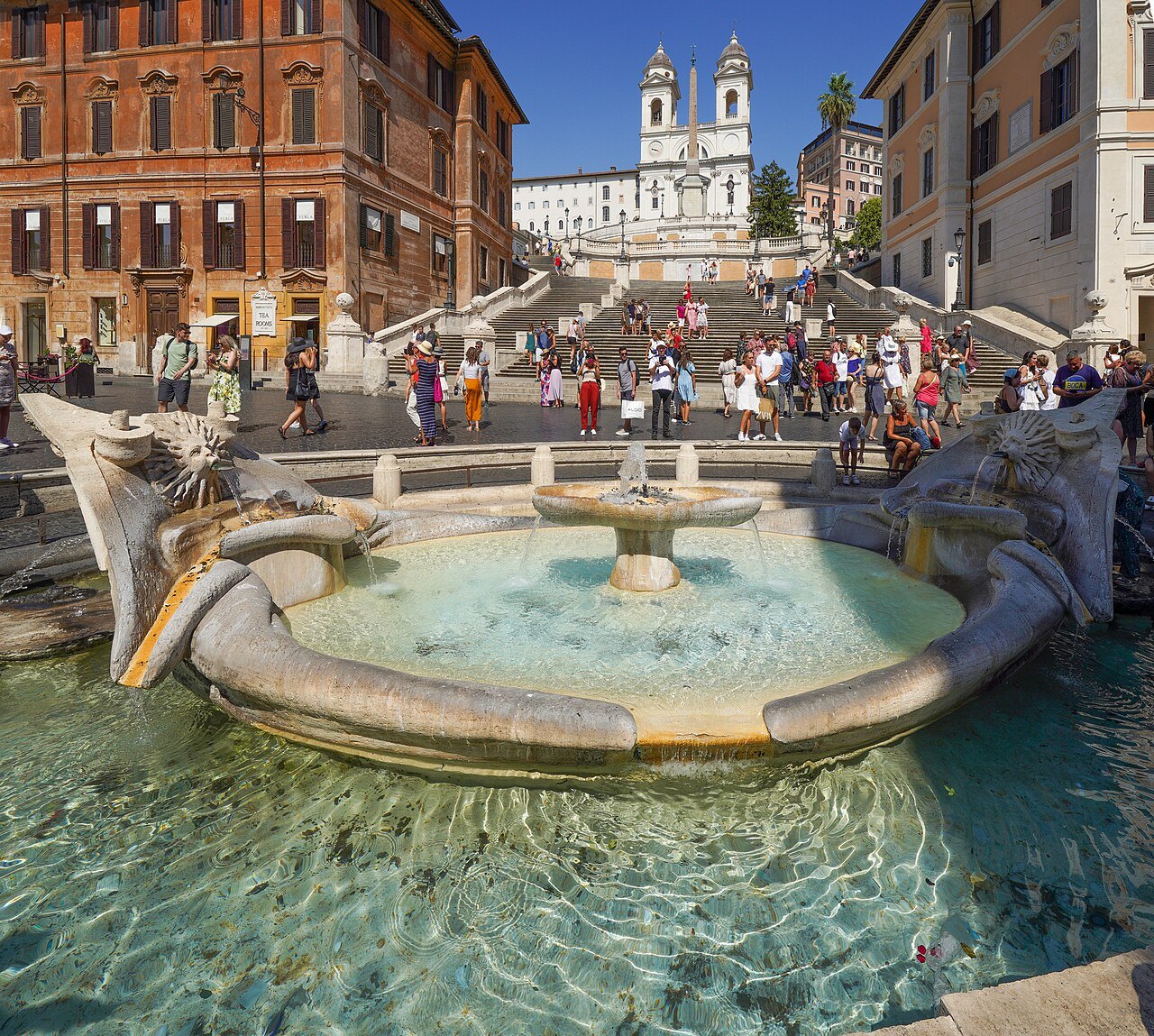
From the base of the obelisk, three streets open out to the south in the fan known as the Tridente: Via del Corso in the center, following the line of the ancient Via Lata; Via del Babuino on the left, opened in 1525, which leads toward the Spanish Steps; and Via di Ripetta on the right, opened in 1518, heading toward the Tiber past the Mausoleum of Augustus.
The two matching churches that frame the openings of the streets, Santa Maria dei Miracoli and Santa Maria in Montesanto, were begun by Carlo Rainaldi and finished by Bernini and Carlo Fontana; despite looking identical from the obelisk, their details differ on close inspection, a Baroque game of variety within symmetry built around the same central landmark.
Because the obelisk stands exactly on the square's long axis, it serves as the pivot for all these sightlines, visible down Via del Corso as far as Piazza Venezia and glimpsed from the terrace of the Pincio above, which looks west over the square toward the domes of the city.
How to see the obelisk today
Piazza del Popolo is a public square with no admission to pay, closed to traffic since its restoration in 1997 and 1998, so the obelisk and its surrounding fountains can be approached on foot from any side, including along Via del Corso or in through the Porta del Popolo itself.
Walk from the obelisk toward the twin churches at the southern end, then into Santa Maria del Popolo at the northeast corner to see its works by Raphael, Bernini, Caravaggio, Pinturicchio and Bramante, including the Cerasi Chapel with two canvases by Caravaggio. It is a place of worship, so dress modestly and keep quiet near services.
From the square, ramps and steps on the east side climb to the Pincio terrace, with its view back over the obelisk and the domes of the city; the route continues on into the gardens of the Villa Borghese toward the Borghese Gallery, for visitors with time to extend the walk beyond the square itself.
Opening arrangements for Santa Maria del Popolo, and any seasonal changes to access on the Pincio terrace, can shift from year to year, so visitors should check current details with the church itself or with Rome's tourist information service before building a visit around them, especially if combining the square with a longer walk into the Villa Borghese.
Read next
More from the journal
- The Capitoline Hill and its MuseumsWhy is the she-wolf the symbol of Rome?How an Etruscan bronze and a Renaissance addition became Rome's emblem, and where to find it today.Read the piece →
- The Roman ForumWhat happened on the Via Sacra in a Roman triumph?How Rome's victorious generals paraded down the Via Sacra, and what still marks their route through the Forum.Read the piece →
- The Borghese Gallery and its GardensHow did Bernini make marble look like skin?Inside the Borghese Gallery, where Bernini carved marble into skin, bark, and breath.Read the piece →