Home · Sights · Piazza del Popolo and the Pincio
What you are looking at
Piazza del Popolo and the Pincio
IV · Campo Marzio
- IThe Flaminio obeliskCarved for Sety I and Rameses II, brought by Augustus in 1 BC, set up here in 1589.
- IIThe Porta del PopoloThe northern gate of the Aurelian Walls, reworked by Bernini in 1655 for Queen Christina of Sweden.
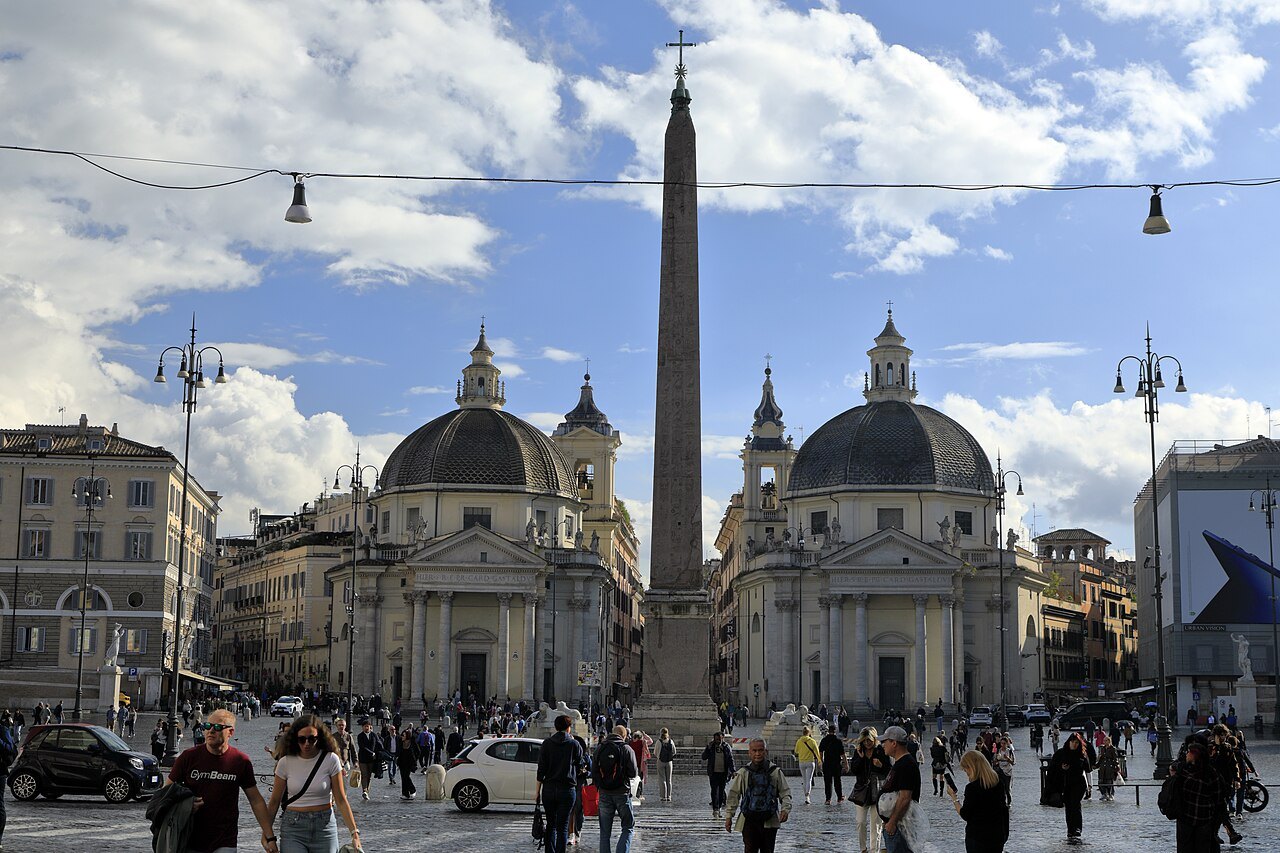
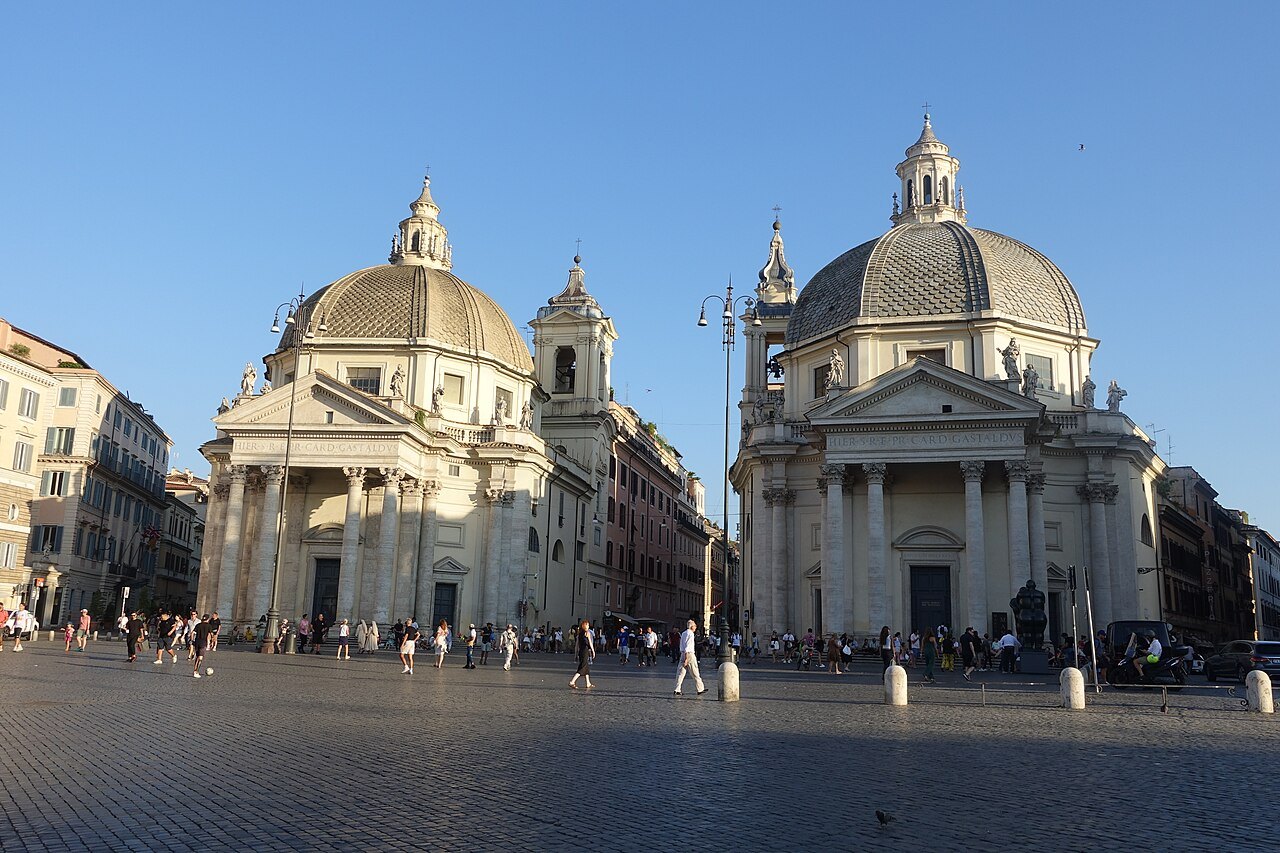
- IIIThe twin churchesSanta Maria dei Miracoli and Santa Maria in Montesanto, alike at a glance, different in detail.
- IVSanta Maria del PopoloA church with two Caravaggios and a chapel designed by Raphael.
- VThe fountainsNeptune on the west side, Rome between two rivers on the east, and four lions round the obelisk.
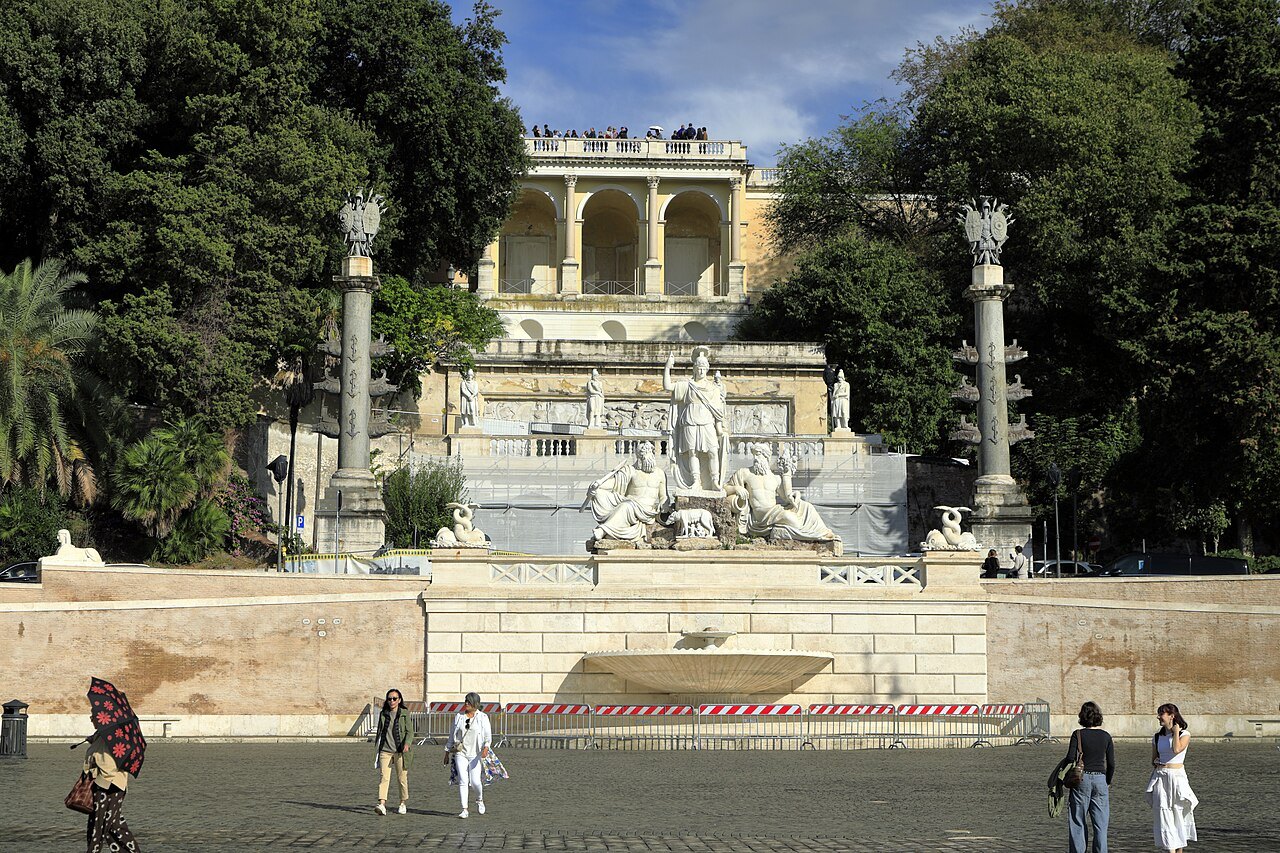
- VIThe Pincio terraceValadier's balustraded lookout above the square, reached by ramps and steps from below.
The sight in full
Reading the place
Why it matters
Before the railways, Piazza del Popolo was a traveler's first view of Rome. It lies just inside the Porta del Popolo, the northern gate in the Aurelian Walls, which was the Porta Flaminia of antiquity and the start of the Via Flaminia, the most important road to the north. Whoever came to Rome overland from the north walked or rode through this gate into this square.
Its name sounds like the people's square, but it comes from the poplars, populus in Latin, that gave their name to the church of Santa Maria del Popolo in its northeast corner. For centuries it was also a place of public executions, the last in 1826. Today it is a broad pedestrian oval in the rione of Campo Marzio, closed to traffic since its restoration in 1997 and 1998, one of the great squares of the city.
Valadier's oval
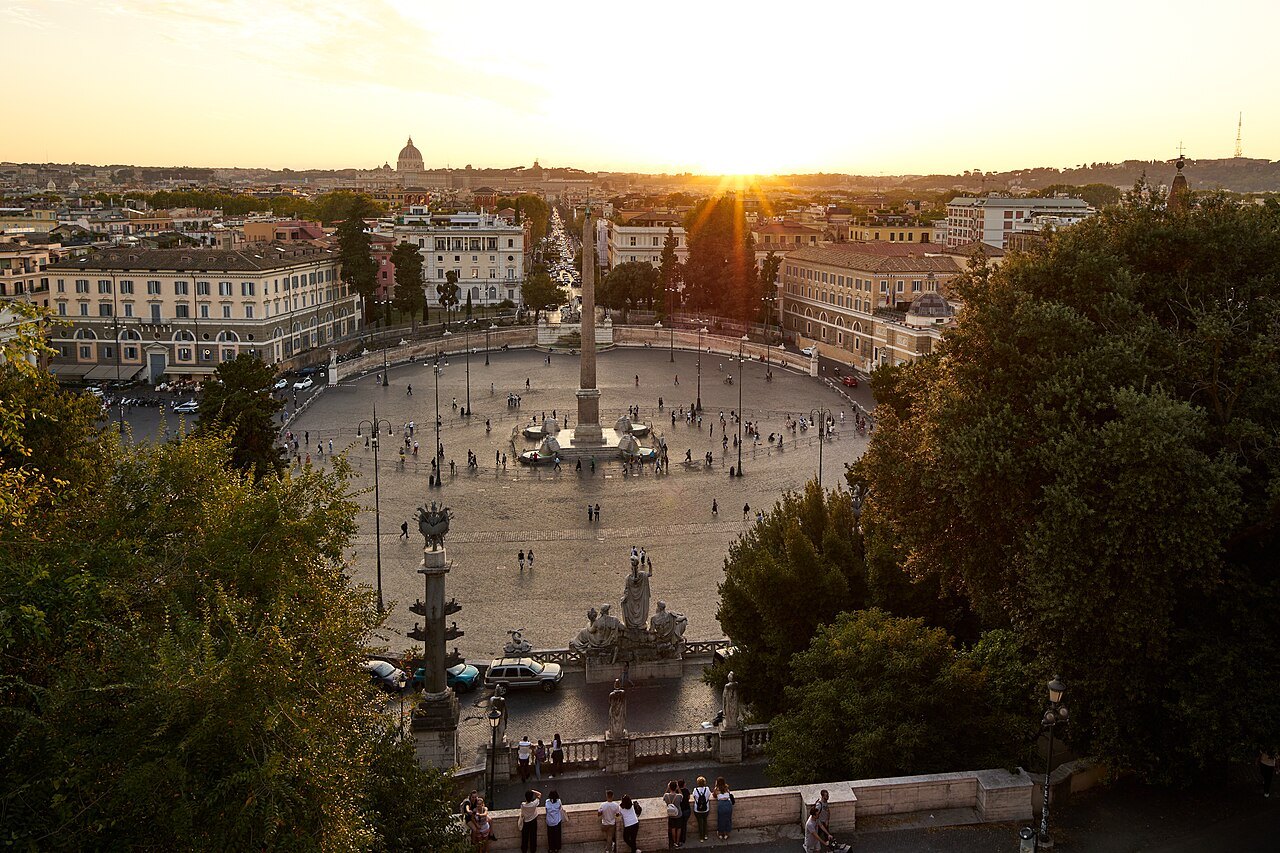
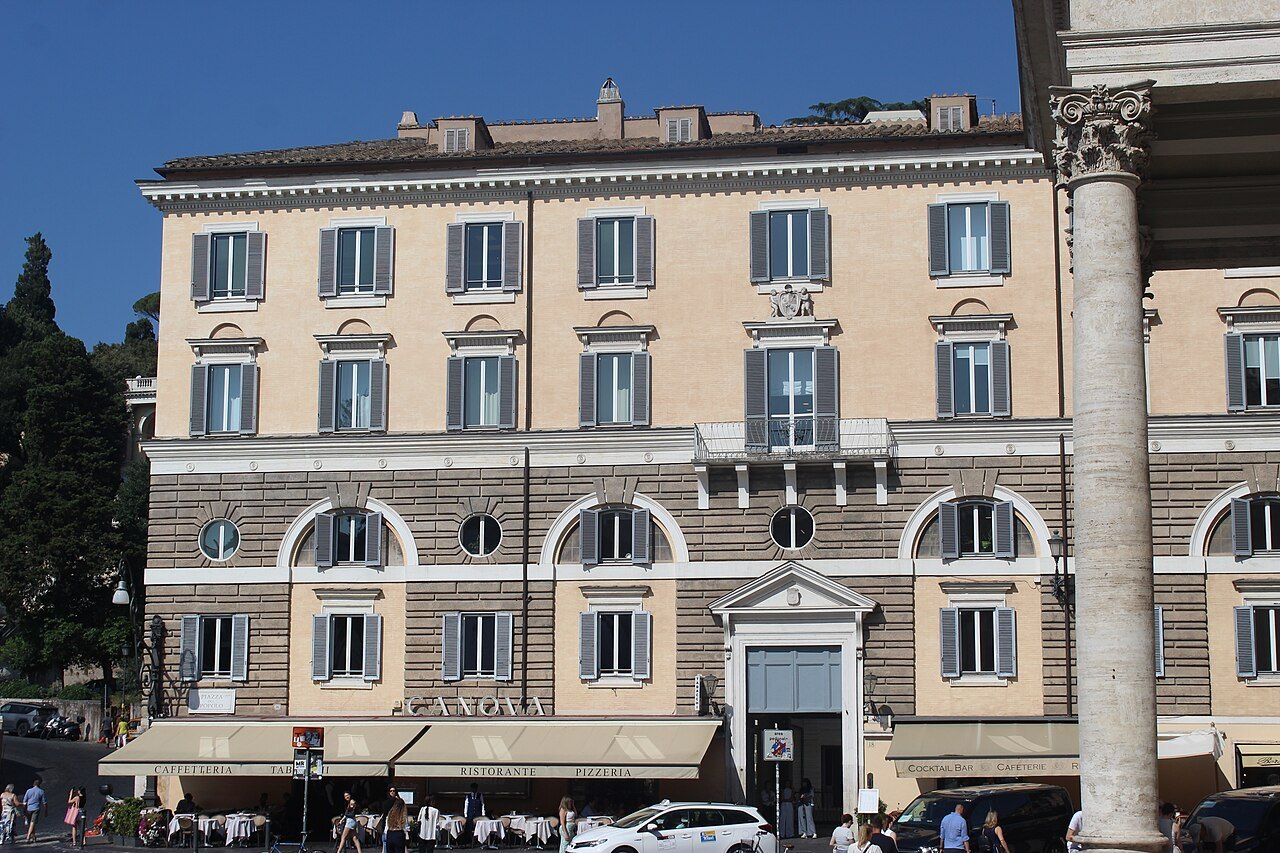
The square you see was designed between 1811 and 1822 by the architect Giuseppe Valadier. He cleared away a cramped trapezoidal space, a small fountain and some haphazard walls and drew two great semicircles, recalling Bernini's colonnades at St. Peter's. Matching palaces frame the twin churches at the southern end, and curved walls with statues of the Seasons, from 1828, sweep round the sides.
Valadier's master stroke was to join the square to the hill above it. On the east side he replaced a monastery's terraced gardens with a carriage drive that doubles back on itself and with steps rising beside a cascade to the Pincio, where a balustraded lookout, carried on a triple-arched fountain, stands on the axis of the square below. He thought in three dimensions, with trees as part of the architecture.
The obelisk and the fountains
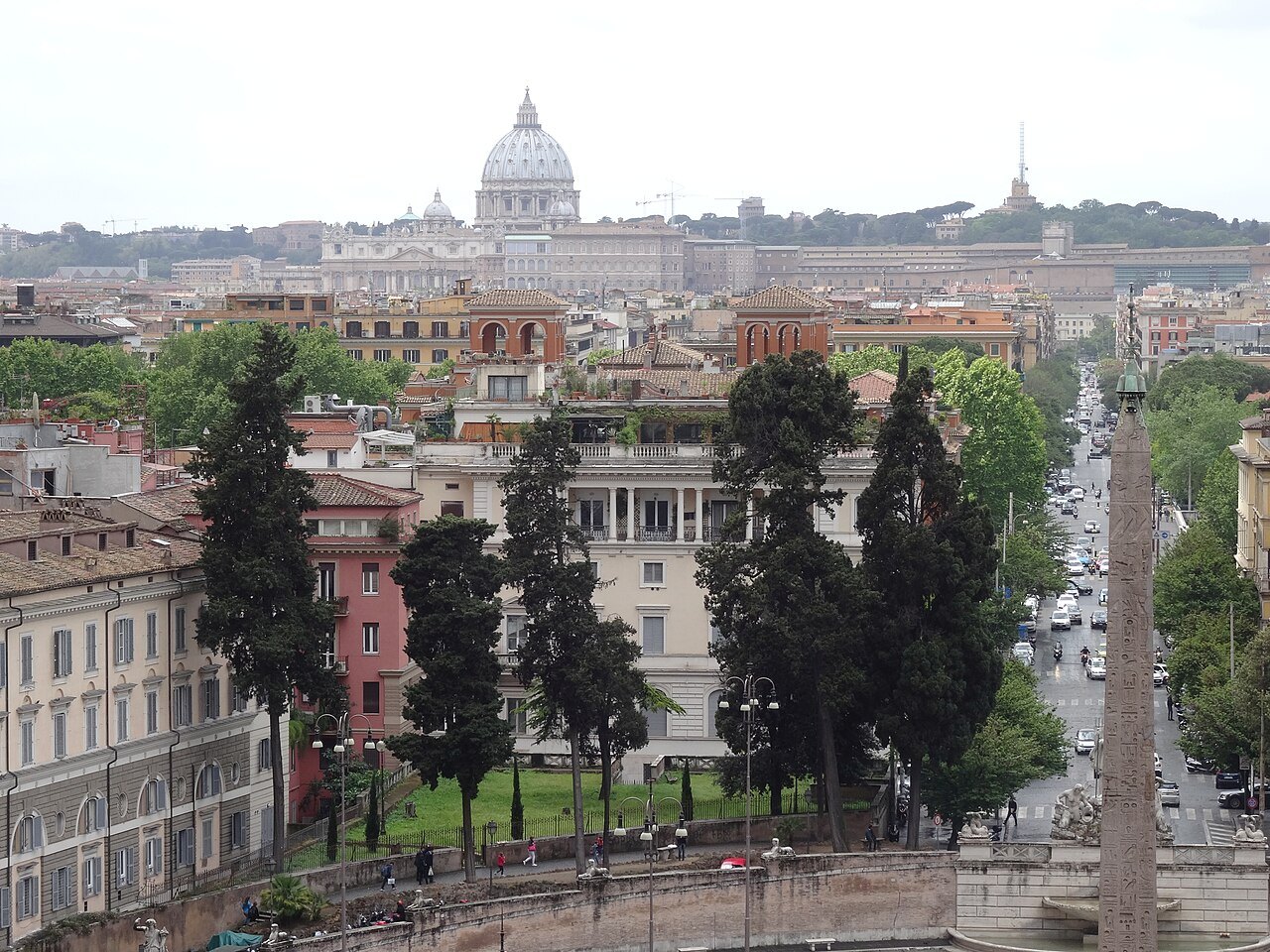
At the center stands the Flaminio obelisk, one of the oldest and tallest in Rome: about 79 feet high, or about 118 feet with its base. Three of its sides were carved in the reign of the pharaoh Sety I and the fourth under Rameses II, at Heliopolis. Augustus brought it to Rome in 1 BC and set it up in the Circus Maximus; Domenico Fontana raised it here in 1589, in the city plan of Pope Sixtus V. Around its base, four stone lions spout water, added in 1818.
The fountains on either side, by Giovanni Ceccarini, date from 1822 and 1823. On the west, Neptune stands with his trident between two Tritons. On the east, against the slope of the Pincio, the goddess Roma, armed with lance and helmet, sits between the Tiber and the Aniene, with the she-wolf feeding Romulus and Remus before her; this is the show fountain of the new Acqua Vergine aqueduct, completed in the 1820s.
The trident and the twin churches
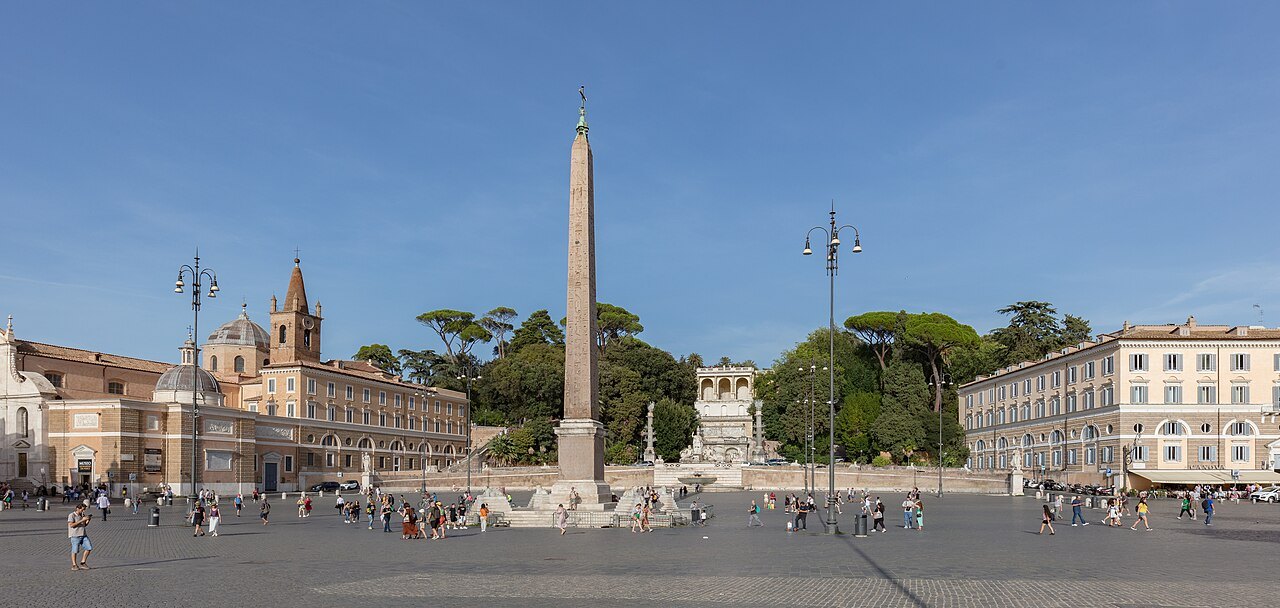
Looking south from the obelisk, three streets fan out into the city, the so-called Tridente: Via del Corso in the center, the ancient Via Lata, running straight to Piazza Venezia and the Capitoline; Via del Babuino on the left, opened in 1525, leading to the Spanish Steps; and Via di Ripetta on the right, opened by Pope Leo X in 1518, passing the Mausoleum of Augustus toward the Tiber. Via del Babuino is named for an ancient statue of Silenus so ugly that Romans called it the baboon.
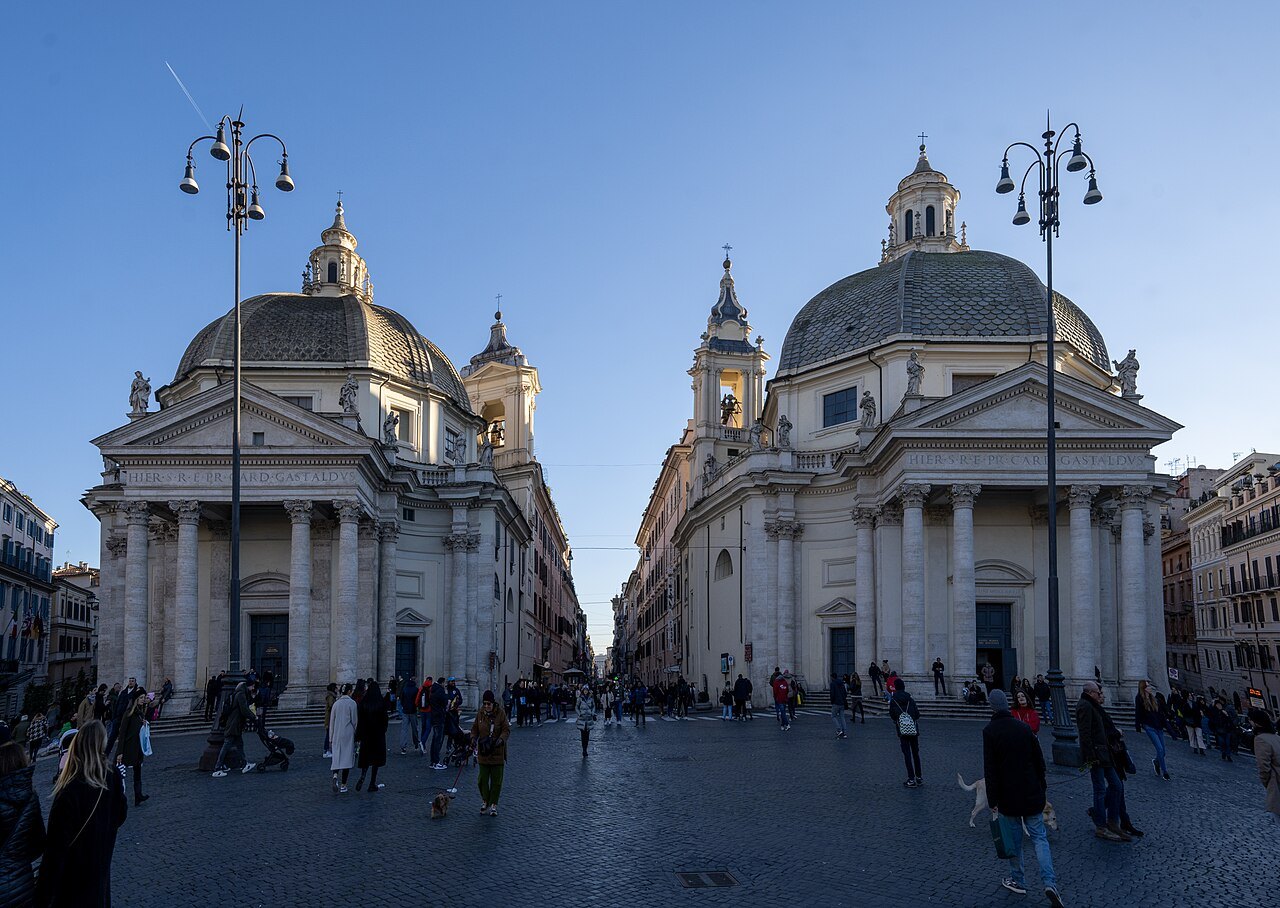
The twin churches that mark the forks, Santa Maria dei Miracoli of 1681 and Santa Maria in Montesanto of 1679, were begun by Carlo Rainaldi and finished by Bernini and Carlo Fontana. Look closely and they are not copies of each other: their details differ, a Baroque game of variety within symmetry.
Santa Maria del Popolo
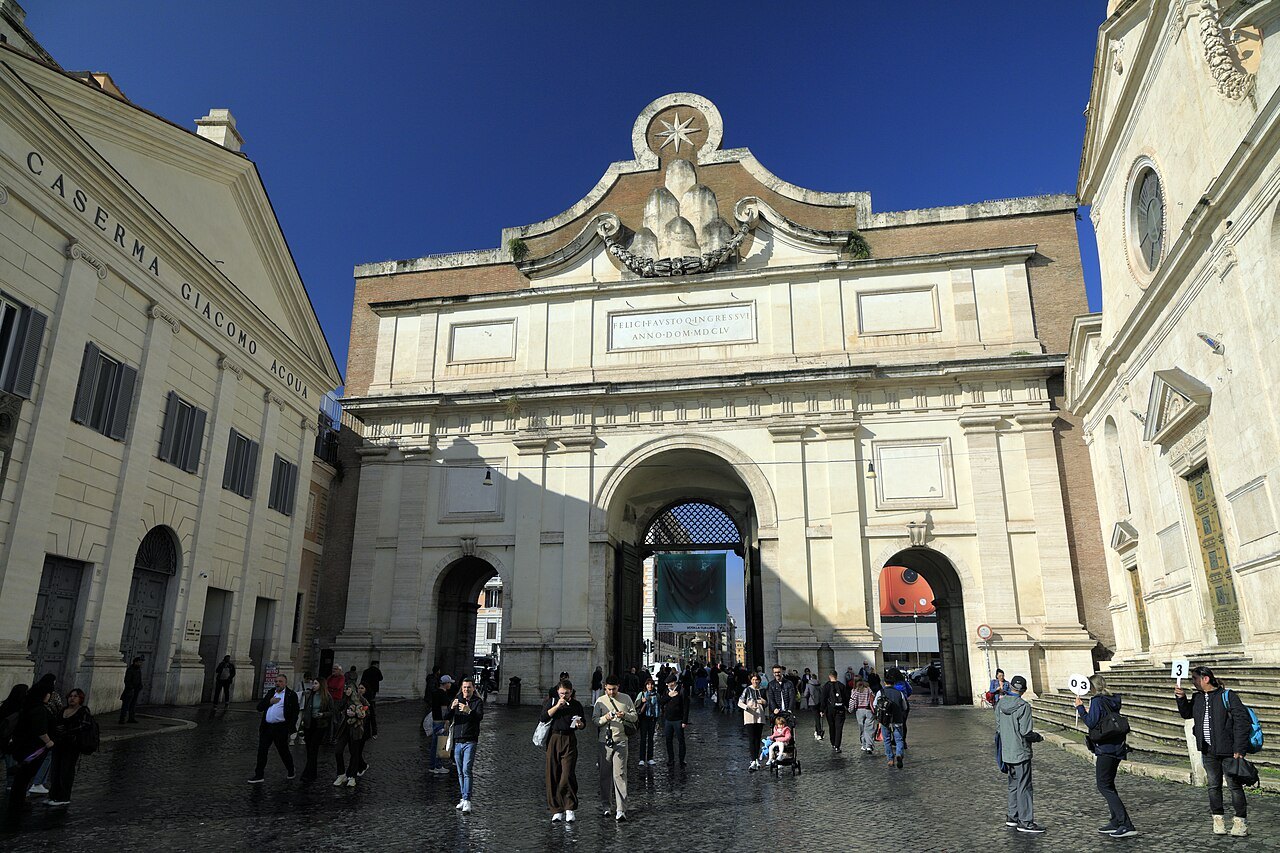
In the northeast corner, beside the gate, stands Santa Maria del Popolo, for centuries the first church most travelers entered in Rome. Legend says that Nero was buried at the foot of the Pincio and that a giant walnut tree over his tomb was haunted, until Pope Paschal II cut it down in 1099, had the remains thrown into the Tiber, and laid the first stone of an altar on the spot.
The church holds works by Raphael, Bernini, Caravaggio, Pinturicchio and Bramante. The Chigi Chapel was designed by Raphael for the banker Agostino Chigi and left unfinished for a long time. In the Cerasi Chapel, designed by Carlo Maderno in 1600 and 1601, hang two great canvases by Caravaggio, the Conversion of Saint Paul and the Crucifixion of Saint Peter, on either side of an Assumption by Annibale Carracci.
The Pincio
The Pincian Hill was not one of the seven hills of ancient Rome, but it lay within the Aurelian Walls. In the late Republic its slopes were covered with the villas and gardens of great families, among them those of Lucullus and of the historian Sallust, and it was known as the hill of gardens; its present name comes from the Pincii, a family who lived there in the fourth century. Valadier's terrace looks west over the square and the domes of the city toward St. Peter's, and the planted Pincio leads straight on into the gardens of the Villa Borghese.
How to visit
The square and the Pincio are public spaces with nothing to pay. Come up from Via del Corso, look at the twin churches from the obelisk, visit Santa Maria del Popolo, then climb the ramps to the terrace and continue into the Villa Borghese toward the Borghese Gallery. The church is a place of worship, so dress with respect and step quietly around services.
Where to go next
Nearby
- Nearby · IV · Campo MarzioThe Spanish StepsOne hundred and thirty-five steps climbing a steep slope from the Piazza di Spagna to the French church of Trinità dei Monti, designed after a competition of 1717 and paid for with a French diplomat's legacy.Read the page →
- Nearby · Outside the walls · PincianoThe Borghese Gallery and its GardensCardinal Scipione Borghese's villa at the edge of old Rome, built to show off his collection: Bernini's marbles in the rooms made for them, six Caravaggios, Canova's Pauline, and around it the third-largest public park in the city.Read the page →
- Nearby · XIV · BorgoCastel Sant'AngeloHadrian's mausoleum, raised on the right bank of the Tiber between 134 and 139, then a fortress, a papal refuge and a prison, and since 1901 a museum, reached across the bridge Hadrian built for it, lined with Bernini's angels.Read the page →