THE METROMARE TO ANCIENT ROME'S PORT
How do you visit Ostia Antica from Rome?
Ostia Antica, the port city of ancient Rome, is the easiest day trip from the center: a suburban train from Porta San Paolo, beside the Piramide Metro stop, takes you to a Roman town preserved under sand. How to get there, what the town was, what to look for among its streets, apartment blocks and baths, and how to plan the day.
The answer in full
Read on
The short answer
Take the Metro's line B to Piramide, walk through to Porta San Paolo station next door, and take the Rome–Lido railway, called Metromare, toward the sea. The line runs out through the suburbs and stops at Ostia Antica before it reaches the modern seaside town. From the station it is a short walk to the ancient site.
The railway is part of the city's integrated fare system, so the same kind of ticket covers the Metro and the train within the municipality of Rome. Check the current rules with ATAC before you travel, and check the archaeological site's own official website for its tickets and closures.
What Ostia was
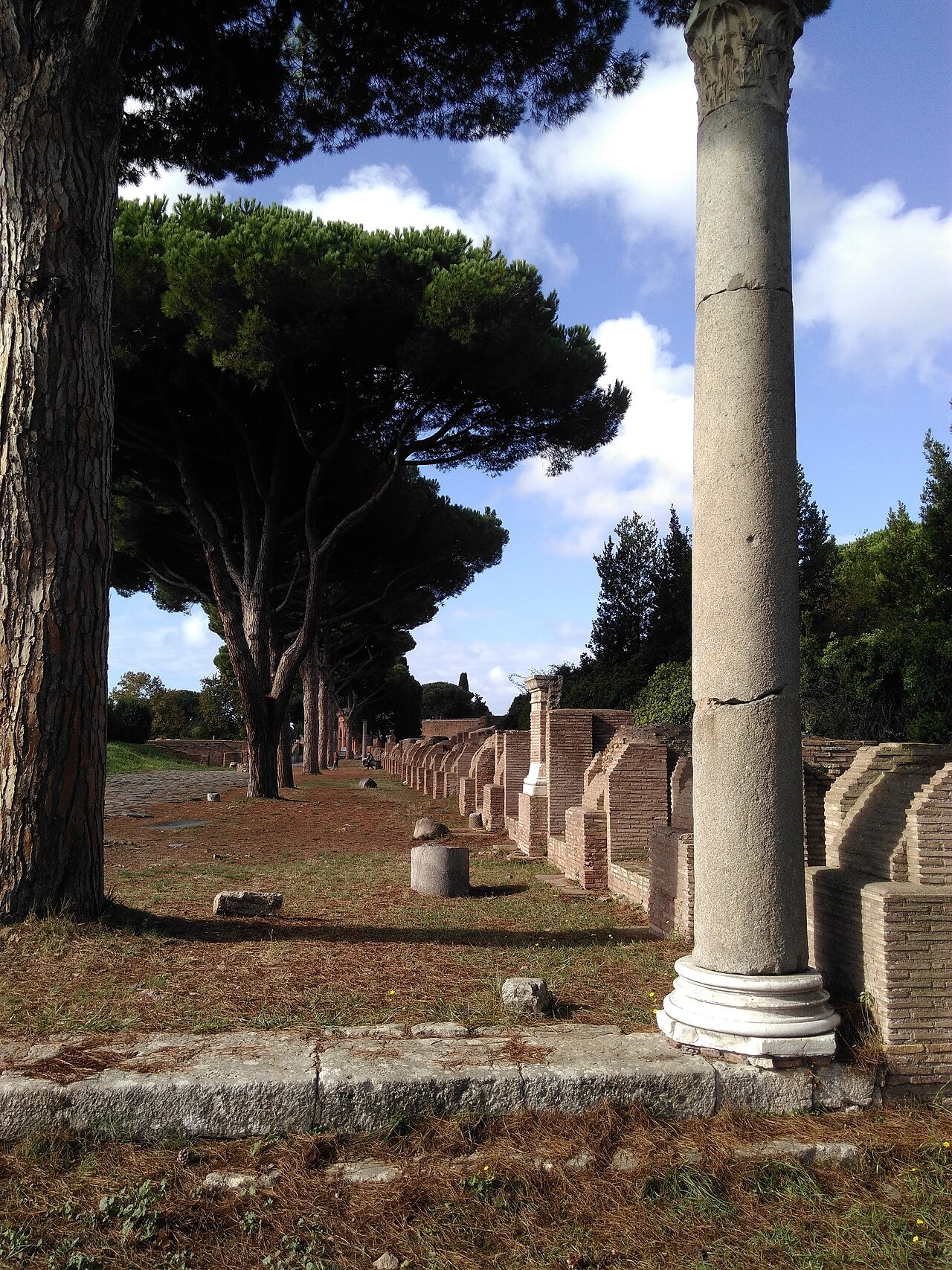
Ostia was the port city of ancient Rome, at the mouth of the Tiber, about sixteen miles southwest of the city; its name is the plural of the Latin ostium, from os, mouth. It may have been Rome's first colony, and the oldest buildings visible today date from the third century BC. Silt carried down by the river has since moved the coastline, and the ruins now lie two miles from the sea.
As the port for the capital's grain, it grew rich. In 68 BC pirates sacked it, burned the port and destroyed a consular war fleet, and the panic in Rome led to the law that gave Pompey the army to clear the seas. Claudius built a great new harbor, Portus, to the north, and Trajan added a hexagonal basin finished in 113, and in the second century Ostia had perhaps fifty thousand inhabitants.
Why it survived
Ostia declined with Rome. After the fall of the Western Empire it slowly decayed, and after a naval battle against Saracen raiders in 849 its last inhabitants moved to a new settlement nearby. For centuries the ruins were quarried for marble for the palaces of Rome.
What saved the rest was the sand. Dunes covered the abandoned town and preserved it so well that only Pompeii and Herculaneum surpass it. As at Pompeii, the remains show details of Roman city life that the city of Rome itself cannot: how people lived, worked, washed and worshipped in an ordinary town. Large-scale excavations took place between 1939 and 1942, and about two-thirds of the ancient town is still unexcavated.
Portus and the grain
Ostia's purpose was food. Rome depended on imported grain, and in the first century an imperial official, the procurator of the grain supply, took charge of it here. Because the old harbor was small, Claudius commissioned a huge new one at Portus, on the northern mouths of the Tiber; storms exposed its weakness, and Trajan added his hexagonal basin, finished in 113, while also developing a harbor at Civitavecchia up the coast.
Ostia remained the administrative center of the grain trade, and its prosperity brought a building boom in the second century. After Constantine made Portus an independent city, business moved there, but recent excavations show that Ostia was not simply abandoned: it became a residential town of rich houses, built with reused materials, while its old workshops and warehouses fell out of use.
What to look for
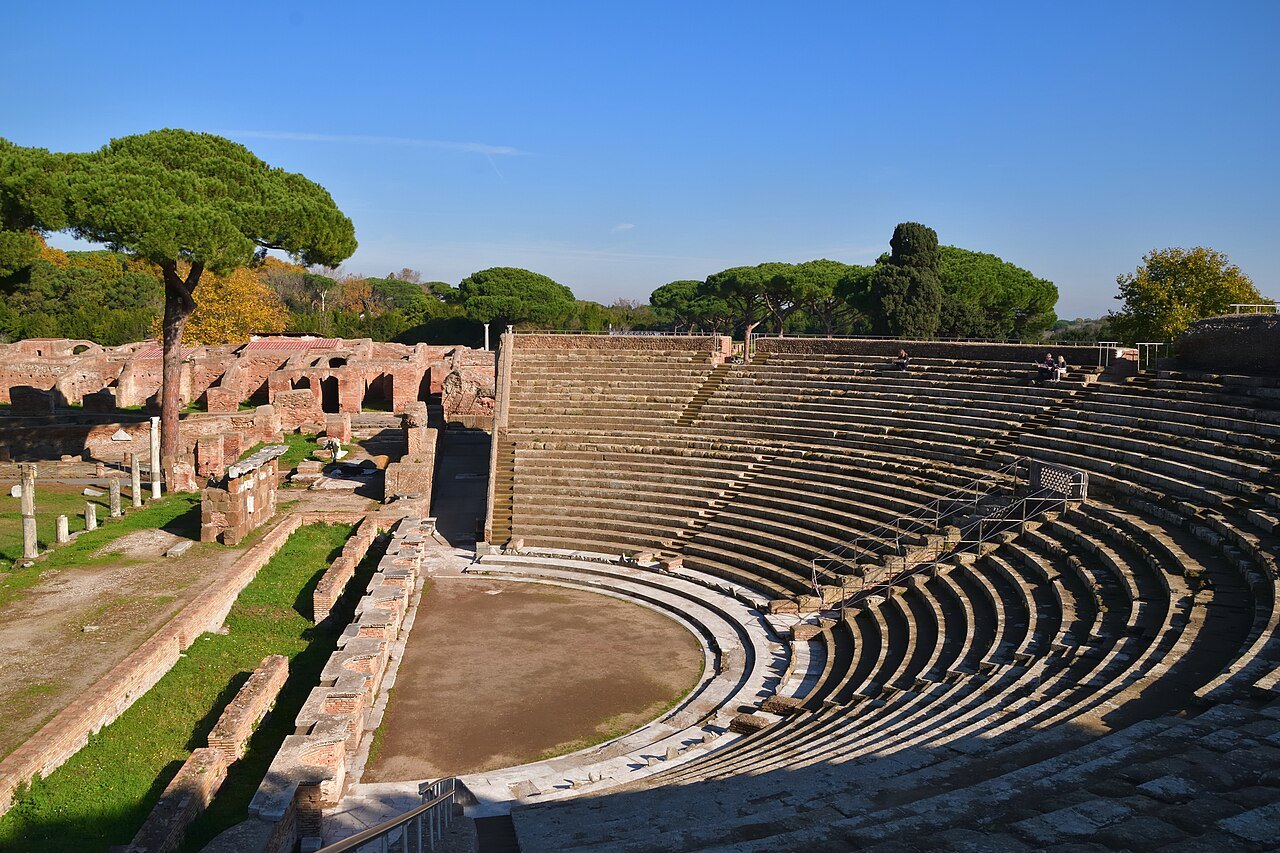
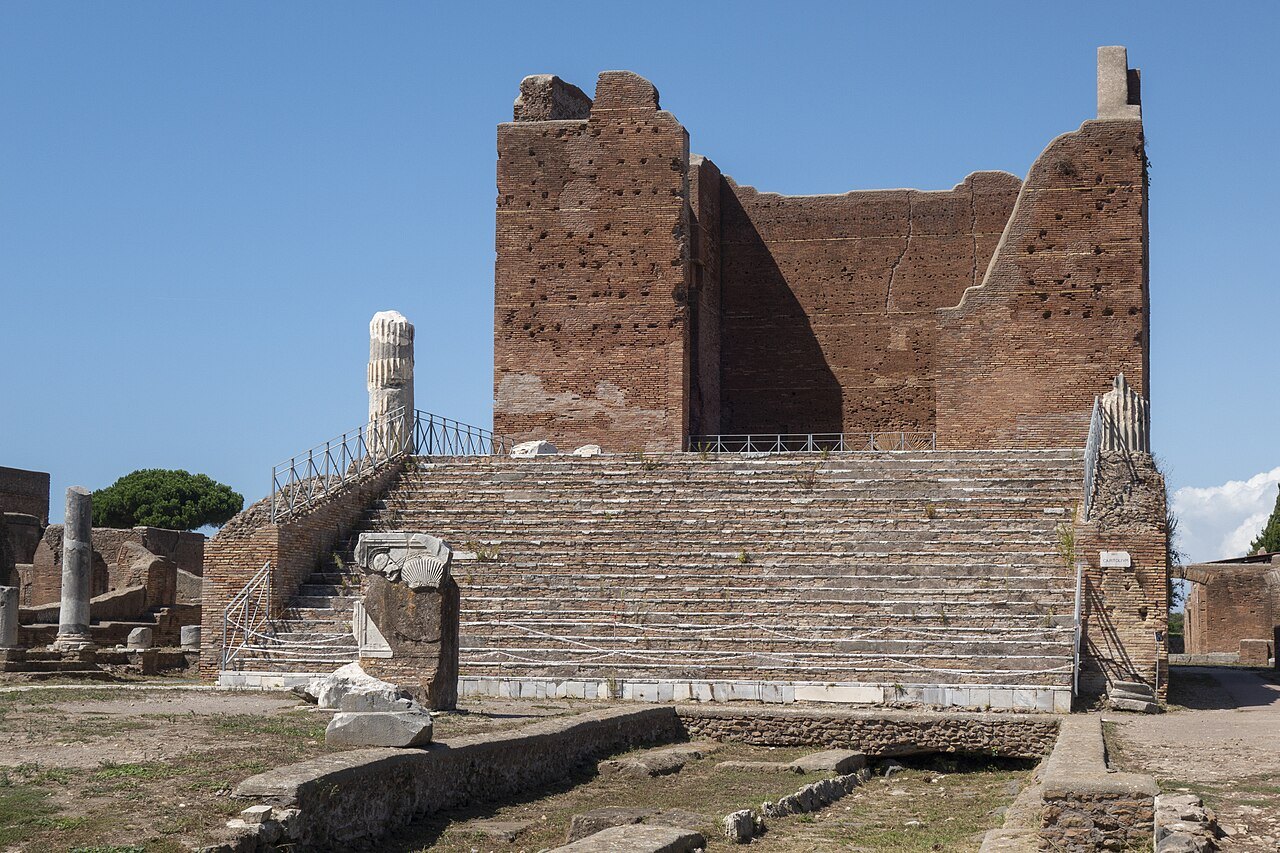
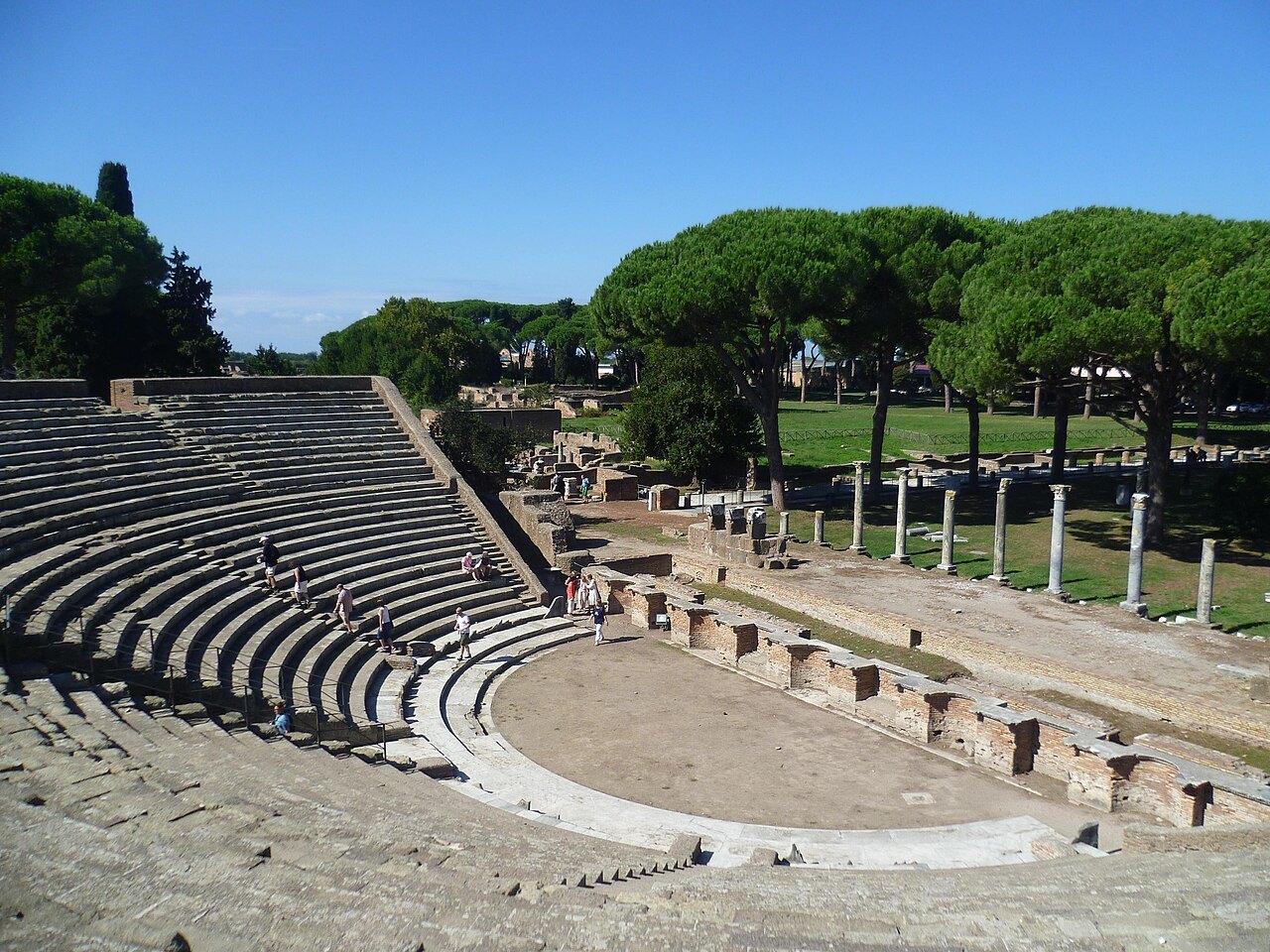
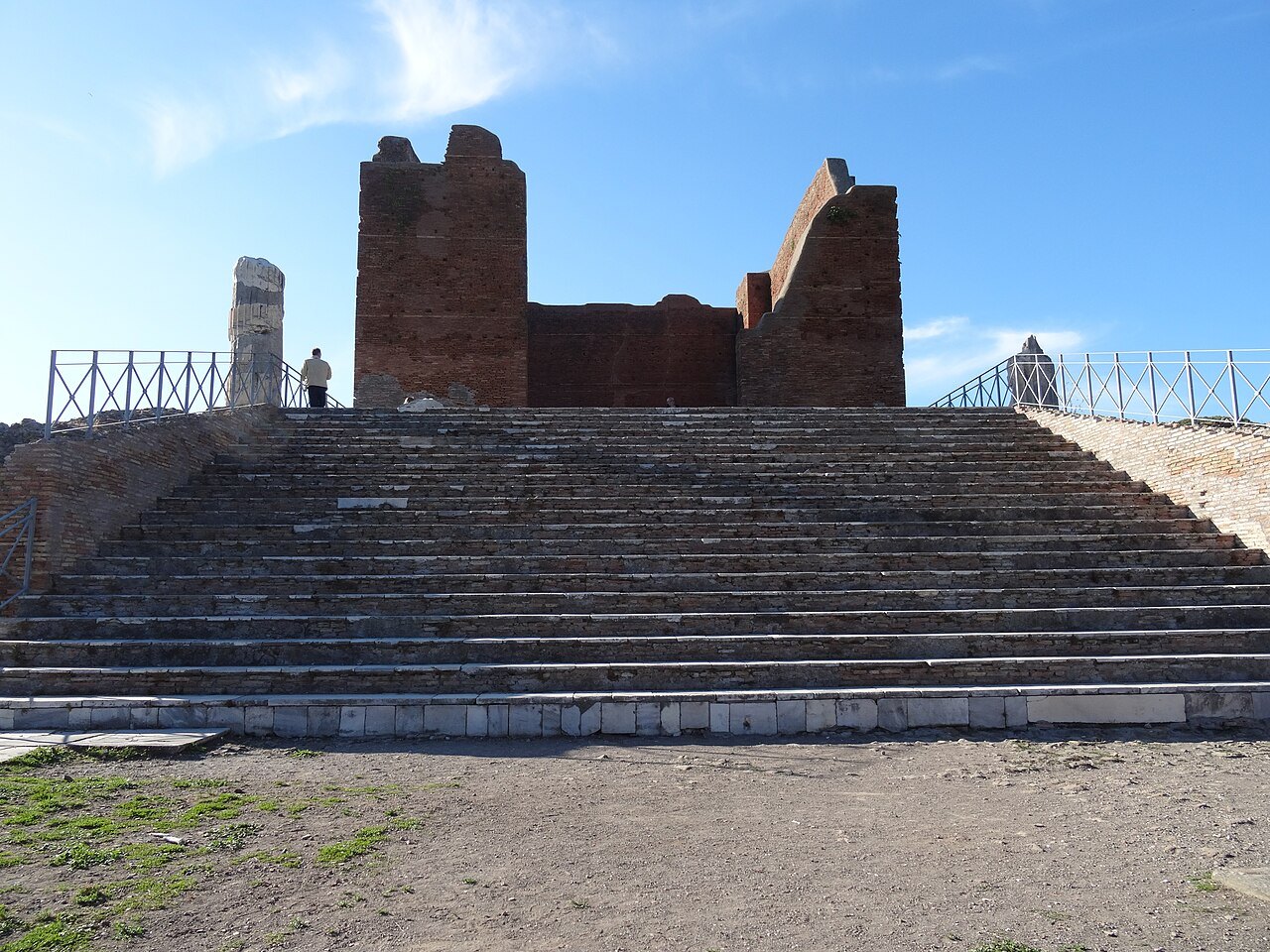
Start with the theater, built under Augustus's general Agrippa between 18 and 12 BC and restored in the Severan age, when a large market was also built. Beyond it lies the forum, probably of the time of Tiberius, with the Capitolium, the temple of Jupiter, Juno and Minerva, at its head, and the Castrum, the oldest part of the town, from the third century BC.
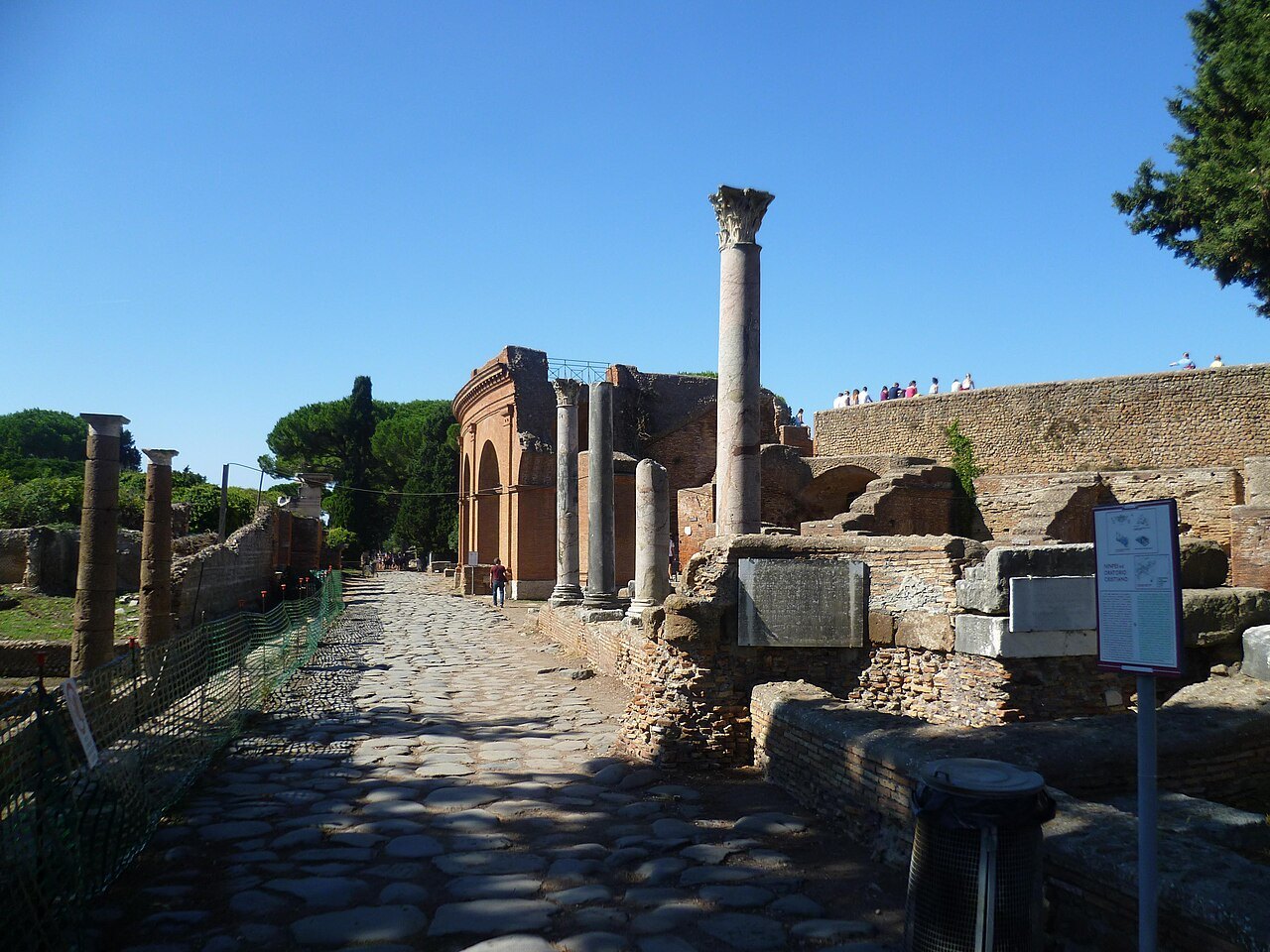
Then look at the houses. Ostia is the best place anywhere to see Roman insulae, the multi-story apartment blocks in which most townspeople lived: shops on the ground floor, separate outside stairs to the cheaper flats above, and in the better apartments a central hall with reception rooms at each end. Some keep floor mosaics and frescoes of red and yellow panels, and the House of the Child Hercules takes its name from a painting of the infant hero strangling serpents.
Baths, gods and a synagogue
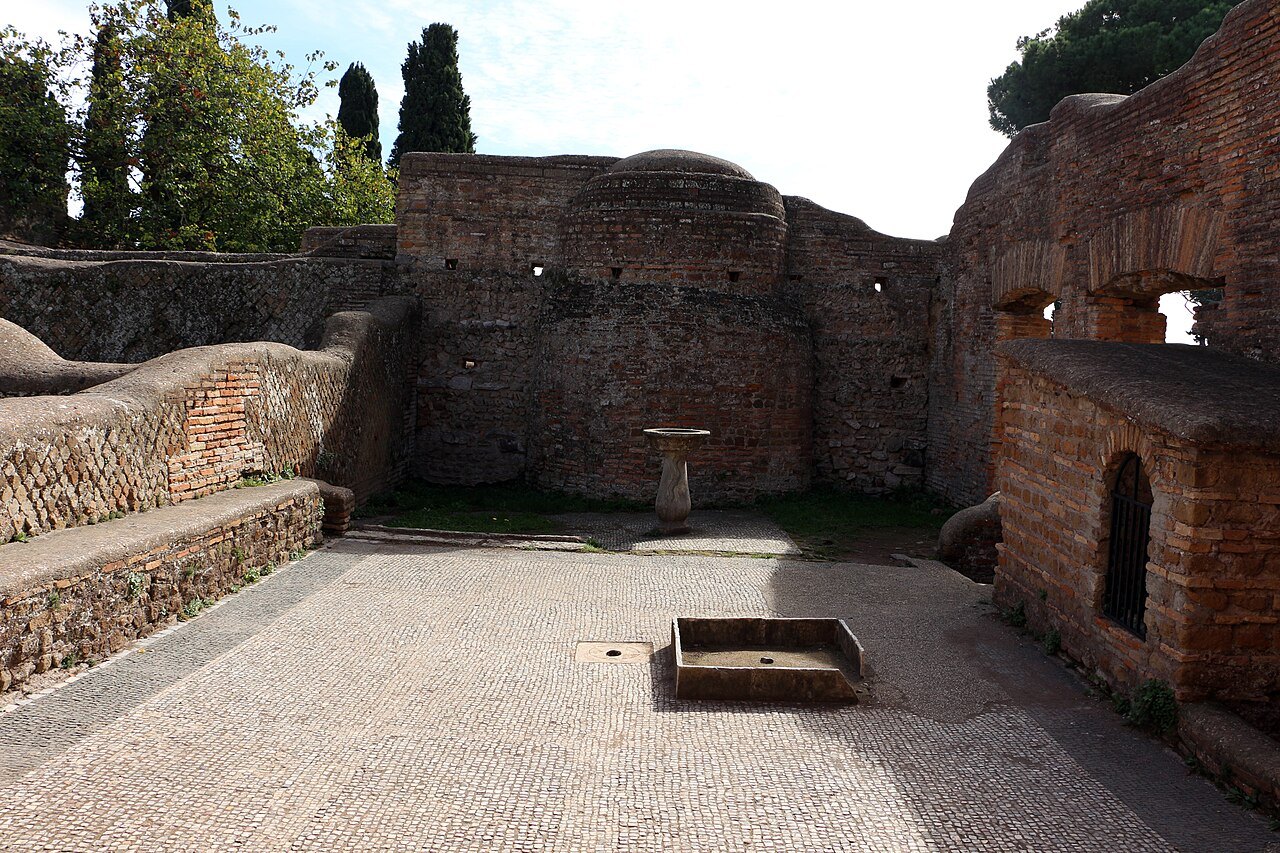
Ostia was a town with every service of its time: a large theater, many public and private baths, taverns and inns, and even a fire service. Twenty-six baths were still working in the fourth century, and the Baths of Neptune, with their mosaic floors, were repaired in the 370s. The cult of Mithras was so popular that eighteen of its meeting places have been found.
The town also holds the Ostia Synagogue, probably built in the late first century, the earliest yet identified in Europe, and in 2025 excavators found what may be the oldest Jewish ritual bath known outside Israel. Saint Augustine passed through Ostia, and his mother, Saint Monica, died here in 387. Finds from the excavations are shown on site in the Museo Ostiense.
Ostia in late antiquity and in fiction
By the end of the fourth century, life had shifted to the edge of town, near the Porta Marina and along the Via Severiana, the coast road from Portus south to Terracina, while many of the old buildings lay in ruins. Rome's own population, some seven or eight hundred thousand around 400, fell to two hundred thousand or less a century later, and Ostia shrank with it.
Readers of Robert Graves will know the town from his novels I, Claudius and Claudius the God, which set scenes at Ostia from the reign of Augustus to Claudius's rebuilding of the harbor.
Planning the day
Give Ostia most of a day. The site is large, much of it open to the sun, and its paved streets and broken floors are uneven, so wear solid shoes, bring water and a hat in summer, and plan a break. The when to come page describes the seasons; spring and fall are the most comfortable.
Combine it with little else. On the way back you can stop at Piramide, on the edge of Testaccio, the old butchers' quarter, where the most traditional Roman cooking is still found. The day trips page describes Tivoli, the Castelli Romani, Orvieto and Cerveteri, and the Baths of Caracalla make a good comparison in the city itself: imperial bathing on the grandest scale, against Ostia's everyday town.
Read next
More from the journal
- Getting AroundHow does the Rome Metro work for visitors?Rome has only three Metro lines, and none of them runs through the heart of the old center. Which line reaches which sights, where they cross, why building them takes so long, how the Metrebus fare system ties them to the buses and trams, and when walking is simply faster.Read the piece →
- The RioniWhy are the districts of Rome called rioni?Old Rome is divided into twenty-two rioni, numbered from Monti to Prati, and their names are carved at street corners. Where the word comes from, how fourteen ancient regions became twenty-two modern districts, what the 1744 plaques are, and how to use the numbers to find your way.Read the piece →
- Getting HereHow do you get from Fiumicino Airport to central Rome?Most visitors take the Leonardo Express, the non-stop train from the airport's own station to Roma Termini. How to find the train, when the regional FL1 line makes more sense, how to recognize an official taxi and its fixed fare to the center, and what to ignore on the way out.Read the piece →